

Award-Winning HOLT Architects Named Upstate New York Affordable Housing Project of the Year
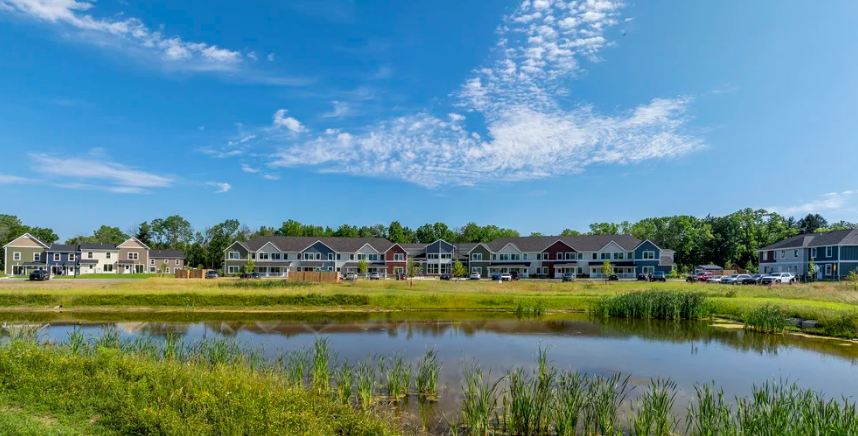

Village Grove Recognized for Passive House Leadership, Community Impact, and Equitable Design
ITHACA, NY, UNITED STATES, February 19, 2026 /EINPresswire.com/ -- Village Grove, a landmark mixed-income, high-performance housing development in Trumansburg designed by HOLT Architects, has been named Upstate New York Affordable Housing Project of the Year by the New York State Association for Affordable Housing (NYSAFAH).The award recognizes HOLT and INHS’s leadership in sustainable design, long-term affordability, and community-centered planning -- positioning the project as a model for equitable housing across New York State.
Designed by HOLT Architects for Ithaca Neighborhood Housing Services (INHS), Village Grove is the first multifamily housing development in Tompkins County to achieve Passive House certification. The recognition honors not only the project’s technical performance, but also its broader social impact, including mixed-income living, long-term affordability, and integration into the fabric of the surrounding village.
“The recognition is especially meaningful because Village Grove represents years of shared commitment between HOLT Architects and INHS to deliver equitable, high-performance housing at a community scale,” said Steve Hugo, a principal at HOLT Architects. “Being named Upstate Project of the Year validates not only the technical achievements, such as meeting rigorous Passive House standards, but also the long-term social impact of creating stable, affordable homes within a connected neighborhood.”
Village Grove is part of a larger mixed-use, mixed-income development and includes 71 total homes: 46 affordable rental units, 11 affordable for-sale homes, and 14 market-rate rental units. The project offers a mix of multifamily apartments and townhouse-style residences, supporting a diverse range of household needs while fostering long-term community stability and economic inclusion.
Designed to Phius Passive House standards, the homes incorporate high-performance insulation, airtight construction, energy-recovery ventilation, and climate-specific solar optimization. Together, these strategies reduce heating and cooling energy use by up to 80 percent compared with conventional construction, while significantly improving indoor comfort, air quality, and durability. The development also utilizes ground-source heat pumps and is pursuing net-zero energy through off-site community solar.
Village Grove has earned multiple state and national recognitions, including selection as a winner in NYSERDA’s Buildings of Excellence competition and certification through Enterprise Green Communities. The project has also achieved Phius Core Certification from the Passive House Institute US, reinforcing its role as a replicable model for low-carbon, resilient affordable housing.
“Building on the lessons from Village Grove, we see our role continuing to evolve as a trusted partner helping communities across New York State address housing affordability, climate resilience, and social infrastructure,” Hugo shared. “Our goal is to take what we’ve learned here and help other communities meet higher sustainability targets while maintaining affordability and long-term community trust.”
HOLT Architects: ‘High-Performance Housing Improves Quality of Life’
Community engagement was central to shaping Village Grove as an integrated neighborhood rather than a standalone housing complex. HOLT executives worked closely with residents, neighbors, local partners, and INHS throughout the design process to ensure the development aligned with both individual needs and the broader Trumansburg community. Input from stakeholders influenced building scale, street connectivity, the creation of a new public road, and the integration of the Trumansburg Community Nursery School, strengthening the project’s connection to the village.
“Direct community engagement allows all constituents to be heard,” Hugo said. “Often there are many competing interests, and not every request can be met. What matters is transparency and ensuring people feel their voices were considered. That process builds trust and leads to stronger, more resilient neighborhoods.”
Balancing developer goals with resident priorities was achieved through early collaboration and performance-based decision-making. By aligning cost discipline, durability, and operational efficiency with resident needs such as comfort, health, and affordability, the project delivers long-term value over the life of the building. Investments in building performance directly translate into lower utility costs, improved indoor environments, and reduced maintenance demands.
Village Grove reflects HOLT Architects’ broader philosophy that architecture should strengthen communities socially, environmentally, and economically. The project blends rental and ownership opportunities, shared-equity townhomes, and community-serving amenities into a cohesive neighborhood that supports long-term inclusion and stability.
“Village Grove reinforced that sustainability, equity, and cost control are not competing priorities,” Hugo said. “When done right, they support one another. High-performance housing improves quality of life for residents while also protecting long-term affordability.”
The project’s impact continues beyond its completion. HOLT Architects has been invited to present Village Grove at the New York State Green Building Conference in Syracuse in 2026, where the firm will share lessons learned with peers across the state. The invitation underscores Village Grove’s value as a scalable model for sustainable, community-focused housing.
Looking ahead, HOLT Architects sees its role expanding as communities across New York State confront housing affordability, climate resilience, and social infrastructure challenges. The firm aims to help municipalities and nonprofit developers pursue higher sustainability targets while maintaining affordability and community trust, particularly in regions of the Northeast that are still early in their adoption of high-performance building standards.
“Recognition is meaningful, but success is ultimately measured over time,” Hugo said. “When residents tell us that access to high-quality, sustainable housing has changed their lives, that is the real outcome. Hearing that a building is both life-changing and beautiful is the highest compliment we can receive.”
ABOUT HOLT ARCHITECTS
Founded in 1963, HOLT Architects is an award-winning architecture firm with offices in Ithaca and Syracuse. The firm has planned and designed hundreds of affordable multifamily housing developments, mixed-use projects, community facilities, healthcare environments, and higher education buildings throughout New York State. Led by principals Kelly Maher, Paul Levesque, Steve Hugo, and Quay Thompson, HOLT employs 40 professionals and is recognized statewide for a high-design aesthetic grounded in functional, durable, and sustainable solutions.
Stephen Kimball
HOLT Architects
email us here
Legal Disclaimer:
EIN Presswire provides this news content "as is" without warranty of any kind. We do not accept any responsibility or liability for the accuracy, content, images, videos, licenses, completeness, legality, or reliability of the information contained in this article. If you have any complaints or copyright issues related to this article, kindly contact the author above.
